Key takeaways
- Ada Lovelace (1843). Her notes on Charles Babbage's Analytical Engine include the first published algorithm intended for a machine. She also foresaw that a machine could process symbols and even compose music.
- Karen Spärck Jones (1972). This Cambridge computer scientist invented IDF (inverse document frequency), which gives more weight to rare words in a set of documents. The resulting TF-IDF remains at the heart of search engines.
- Fei-Fei Li (2009). She created ImageNet, over 14 million annotated images, whose competition in 2012 triggered the rise of deep learning. She then co-founded AI4ALL to diversify AI talent.
- Rana el Kaliouby (2009). Born in Cairo, she co-founded Affectiva, a pioneer of "Emotion AI" that analyzes facial and vocal expressions.
Introduction: AI, a Challenge for Diversity and Inclusion
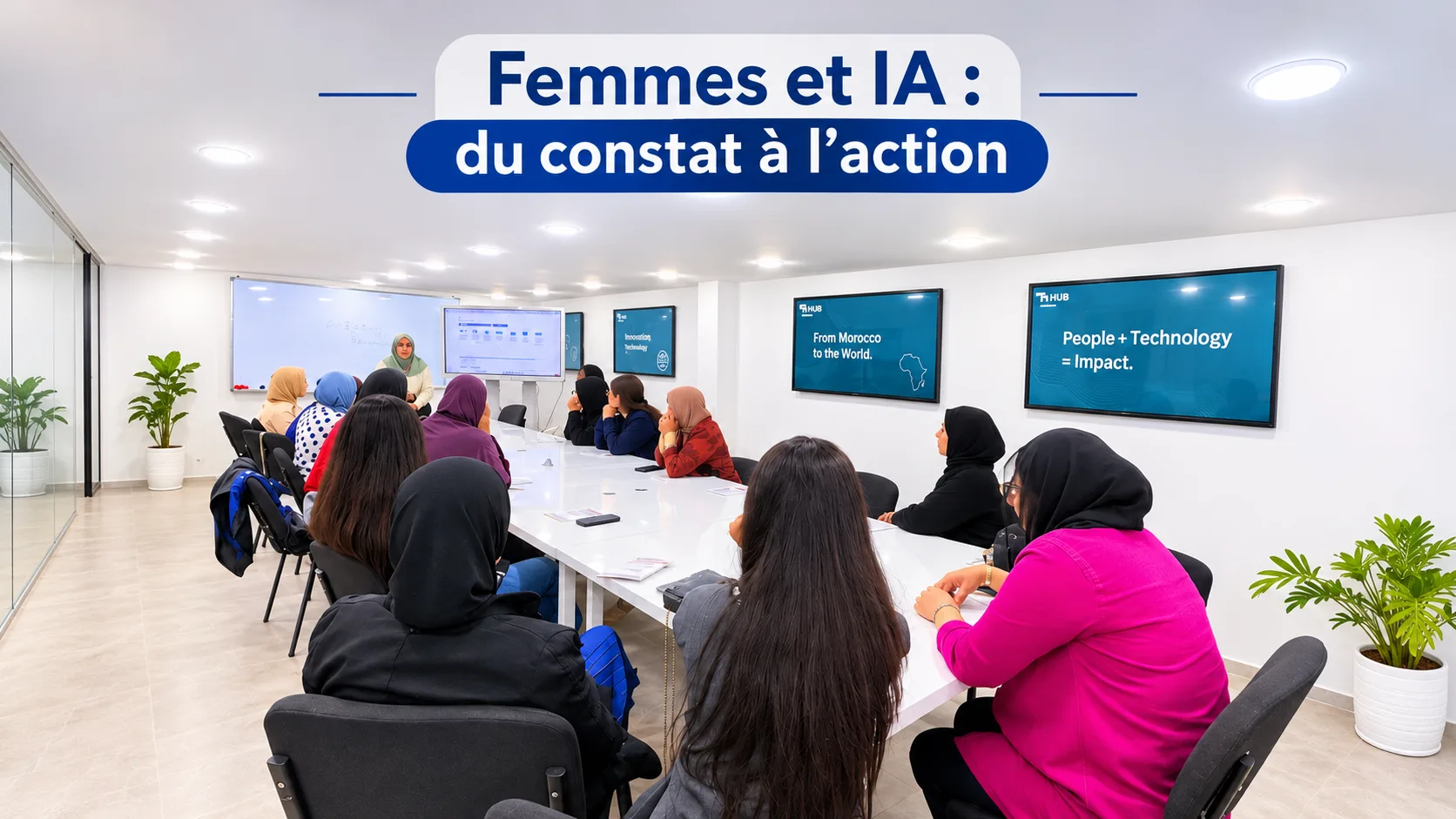
We rarely ask who builds artificial intelligence, even though it increasingly decides many things: which CV is read, which face is recognized, which answer appears first. On October 30, in Rabat, AI4Morocco and AI HUB brought together a community around this question during a networking evening titled Women and AI: From Observation to Action.
The event was led by Salma Gherraby, founder and CEO of DEVSTRATECH, an AI and digital transformation expert, and Research & Innovation Lead for Women in AI Morocco. Her journey serves as the best entry point: a bachelor's degree in applied mathematics, a master's in systems theory and computer science (Imagine Cup Morocco 2014 Award), doctoral research in combinatorics and algebra, the TechWomen program in Silicon Valley in 2019, followed by the creation of DEVSTRATECH in 2023. She teaches at ESLSCA Paris, UIR, UM6P, and HESTIM, and has trained over 2,000 people in AI, both in companies and universities. She describes her path as "non-linear," with a common thread: democratizing digital technology and AI through human skills development.
Her presentation followed three stages: observation, opportunities, and levers.
AI Pioneers: A History of Female Contributions
Before the numbers, a reminder: women are not new to AI. They have marked almost every stage of its history.
- Ada Lovelace (1843). Her notes on Charles Babbage's Analytical Engine include the first published algorithm intended for a machine. She also foresaw that a machine could process symbols and even compose music.
- Karen Spärck Jones (1972). This Cambridge computer scientist invented IDF (inverse document frequency), which gives more weight to rare words in a set of documents. The resulting TF-IDF remains at the heart of search engines.
- Fei-Fei Li (2009). She created ImageNet, over 14 million annotated images, whose competition in 2012 triggered the rise of deep learning. She then co-founded AI4ALL to diversify AI talent.
- Rana el Kaliouby (2009). Born in Cairo, she co-founded Affectiva, a pioneer of "Emotion AI" that analyzes facial and vocal expressions.
- Daphne Koller (2012). Co-founder of Coursera, she opened courses from major universities to the entire world.
- Joy Buolamwini (2018). With Timnit Gebru, she revealed the biases in facial analysis systems (we will return to this below).
- Mira Murati (2022). OpenAI's CTO during the launch of ChatGPT, which put generative AI into everyone's hands.
The Current Paradox: Underrepresented and Exposed Female Talent
Morocco also has its pioneers who are building the ecosystem: Ghita Mezzour, who led the Digital Morocco 2030 strategy; Amal El Fallah Seghrouchni, an expert in multi-agent systems; Saida Belouali, a specialist in AI ethics at Mohammed I University; Maha Gmira, whose ICESCO-UEMF "Women in Science" chair brought together over 4,000 women around AI; Lamiae Azizi (UM6P), Hajar Mousannif (Cadi Ayyad University), Kaoutar El Maghraoui (IBM Research), and Kenza Ait Si Abbou, who demystifies AI in her book Keine Panik, ist nur Technik.
This is probably the most telling figure of the evening. In Morocco, 42.2% of engineering graduates are women, a proportion higher than that of many OECD countries (UNESCO, via Médias24, 2021). However, only 16.8% of women are active in 2024, compared to 20.4% in 2014, and 30.2% of female higher education graduates are unemployed, compared to 17.9% of men (CEMRAP study, via Hespress, 2026).
Morocco trains talent, then loses it along the way.
The higher up you go, the fewer women there are.
The same phenomenon appears internationally. In the United States in 2025, women represent 50% of non-AI hires, 26% of AI hires, and 13% of leadership positions in AI companies (LinkedIn Economic Graph). In tech in general, they make up 29% of the workforce and 14% of leadership positions (UN, Gender Snapshot 2025).
And AI concerns them very closely: 28% of jobs held by women are exposed to automation by AI, compared to 21% for those held by men (UN, 2025).
The speaker's conclusion can be summarized in one sentence: more exposed to AI, less present where it is built.
When AI Reproduces Biases: Concrete Examples
This imbalance is not just a matter of internal equity. It is reflected in the products. Four documented cases were presented:
- Recruitment. A CV screening tool tested by Amazon penalized the word "women's." Trained on past applications that were mostly male, it had learned to exclude female profiles. It was abandoned (Reuters, 2018).
- Language. Models trained on Google News associated "man" with "programmer" and "woman" with "homemaker" (Bolukbasi et al., 2016).
- Voice assistants. Default female voices, complacent responses to harassment: UNESCO pointed out Siri, Alexa, and Google Assistant (2019).
- Generative AI. According to UNESCO (2024), Llama 2 describes women in domestic roles about four times more often than men.
Emerging Opportunities for Women in AI
And the most telling example remains that of facial analysis. The Gender Shades study (2018), by Joy Buolamwini and Timnit Gebru, measured up to 34.7% errors for dark-skinned women, compared to at most 0.8% for light-skinned men. This work pushed large companies to review their systems and fueled the debate on regulation. Joy Buolamwini founded the Algorithmic Justice League.
Not everything is bleak. According to the WEF and LinkedIn (March 2025), the AI skills gap between women and men narrowed in 74 out of 75 economies between 2018 and 2025. On Coursera, 36% of enrollments in generative AI courses came from women in 2025, compared to 32% in 2024. However, they still represent less than a third of qualified AI professionals.
Three doors are opening, according to Salma Gherraby:
- Prototyping without coding. Generative AI and no-code lower the technical barrier.
- Faster entrepreneurship. Testing an idea, an offer, or a market in a few days.
- Access to new professions. AI governance, responsible AI, business integration.
Accelerating Change: Individual Levers and Collective Framework
Three individual levers were proposed:
- Continuous learning, and showing it. Certifications, concrete projects, portfolio: making one's skills visible.
- Speaking up. Publishing, speaking, applying for awards and programs.
- Networking. Networks, mentorship, communities of practice: advancing together.
A Call to Action and Exchange
Regarding the legal framework, Morocco already has support: Article 19 of the 2011 Constitution (equality and parity objective), the UNESCO Recommendation on the Ethics of AI signed in 2021, and the Digital X.0 bill, which announces transparency and non-discrimination. In Europe, the AI Act classifies recruitment AI among "high-risk" systems, with obligations expected from December 2027. This is a direct challenge for Moroccan companies linked to the European market.
What we can collectively demand: gender bias audits, sex-disaggregated data, and parity in AI governance.
The evening concluded with a simple challenge: choose a lever that night, stick to it for 30 days, and talk about it with the person sitting next to you. The Q&A session revolved around two questions: what obstacle has cost you the most so far? and what AI tool has changed the way you work?
Thanks to Salma Gherraby for her intervention, and to all participants and attendees for the quality of the discussions. To find the speaker: linkedin.com/in/salmagherraby · devstratech.com.
To participate in our next meetings, follow AI4Morocco and check our events on aihub.ma.
Author
AI HUB Editorial
Research Desk