Key takeaways
- Nationwide Jazari Institute network across all 12 regions
- Target of 50,000 high-value jobs in data science and AI
- Sovereign cloud infrastructure: local data centers and robust cybersecurity
- Massive skilling initiative: 1 million talents trained by 2030
Where Does the Morocco AI 2030 Plan Come From?
For months, "AI" has echoed through every keynote, corporate meeting, and vendor pitch. Amid the buzz, it has become difficult to distinguish genuine structural change from marketing noise.
At AI HUB, we closely analyzed the actual substance of the Morocco AI 2030 national roadmap. Stripping away slogans, we asked the essential pragmatic question: if you run an SME, a professional practice, an agency, or a business in Rabat, Casablanca, Marrakech, or across the Kingdom, what does this actually change for your bottom line?
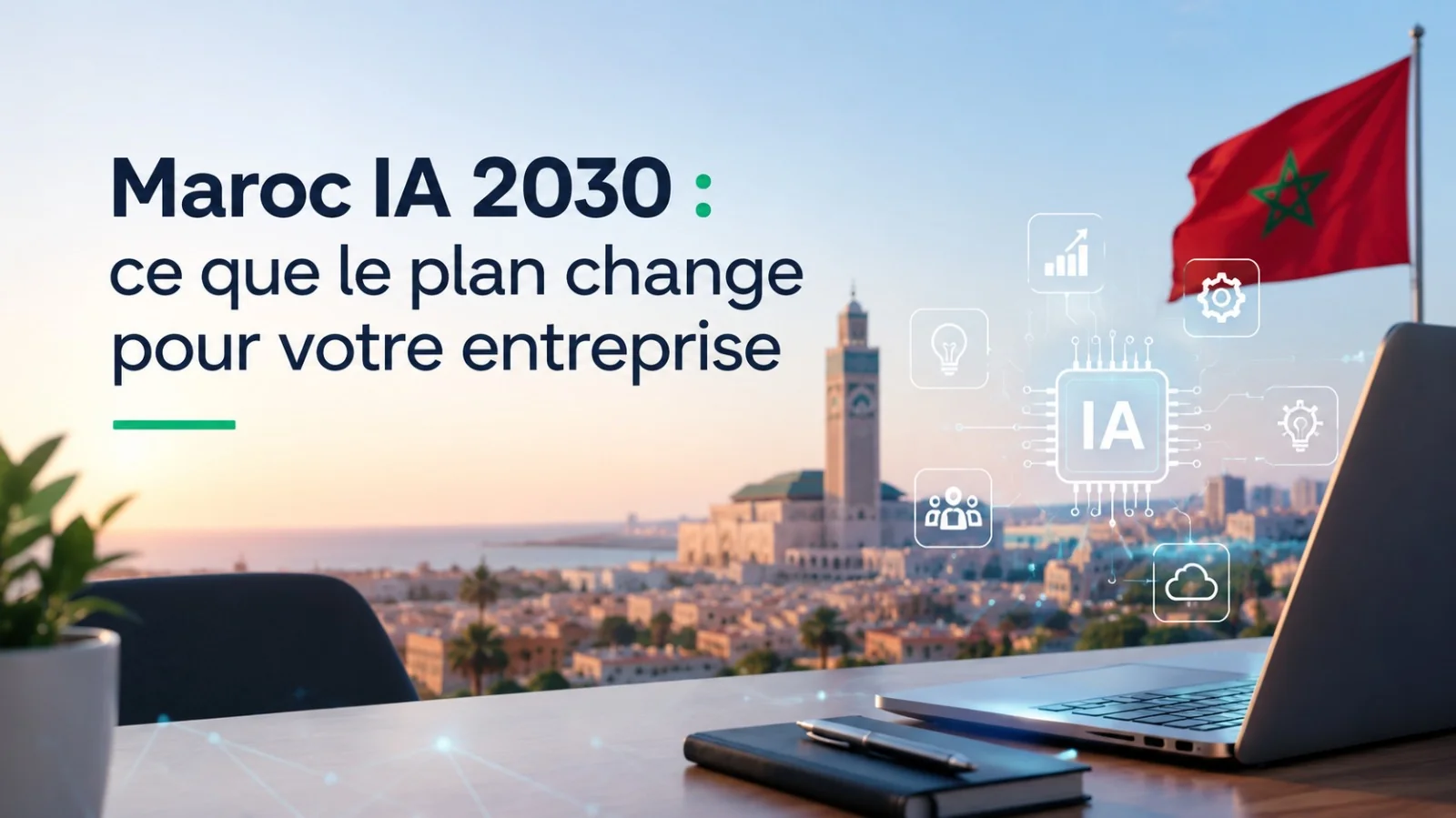
Morocco AI 2030 builds upon the outcomes of the National AI Conference held at UM6P Rabat in July 2025, aimed at creating sovereign AI models tailored to local languages and industry needs. Fully aligned with Digital Morocco 2030 and presented during "AI Made in Morocco", this vision is clear: ensuring Morocco actively steers the AI wave rather than passively consuming it.
Core Pillars: Jazari Institutes, Infrastructure, and Scaled Talent
The national strategy rests upon foundational pillars designed to power the next generation of Morocco's digital economy:
The flagship initiative is the nationwide deployment of Jazari Institutes across all twelve regions of the Kingdom. These specialized hubs will lead research, train software engineers, and incubate high-growth startups, ensuring innovation thrives beyond the traditional Rabat-Casablanca corridor.
On the infrastructure side, state-of-the-art data centers and heightened cybersecurity frameworks will enable enterprises to store and process strategic data within national borders—a vital milestone for regulatory compliance and trust in healthcare, banking, and legal sectors.
In parallel, an ambitious human capital roadmap aims to train one million young Moroccan and African talents in AI by 2030 in collaboration with leading global partners.
- Nationwide Jazari Institute network across all 12 regions
- Target of 50,000 high-value jobs in data science and AI
- Sovereign cloud infrastructure: local data centers and robust cybersecurity
- Massive skilling initiative: 1 million talents trained by 2030
The Real Breakthrough for Business: Native Darija & Amazigh Support
If there is one milestone that directly shifts daily operations for businesses, it is this breakthrough.
Morocco has formed a strategic alliance with Mistral AI to develop cutting-edge models natively tailored to Moroccan Darija and Amazigh, integrating these capabilities into public administration and enterprise workflows.
Why is this crucial? Because existing large language models perform well in English and French, but struggle with how Moroccans naturally communicate. A customer inquiry written in Darija, blending French terminology, or typed in Arabizi (Latin script with numbers) routinely breaks generic chatbots.
Native language comprehension unlocks immediate, practical business value:
- WhatsApp customer support agents conversing fluently in authentic local dialect
- Social media campaigns and marketing copy that sound natural, engaging, and culturally grounded
- Client-facing portals and onboarding workflows accessible to every segment of the population
Geopolitical Dimension: The "Third Way" for Technological Sovereignty
Beyond technology, Morocco's strategy carries clear geopolitical intent. Formalized at GITEX Africa in Marrakech, the national agenda advocates for a "third way", positioning the Kingdom as an independent and balanced tech power amid global competition.
As emphasized by CGEM President Chakib Alj, AI is no longer a distant theoretical promise—it is now a core economic infrastructure, as essential as electricity, logistics, or telecommunications.
This orientation establishes Morocco as a trusted digital bridge between Europe, Africa, and the Arab world. For founders and business leaders, this provides a resilient launchpad to expand across continental and international markets.
A Grounded Reality: Execution Challenges on the Ground
A balanced analysis requires candid assessment. Between high-level roadmap announcements and tangible daily impacts for businesses, critical execution hurdles remain:
Procurement timelines, infrastructure deployment, substantial capital requirements, and intense talent competition cannot be resolved overnight. Furthermore, technological autonomy carries a significant price tag, and current workflows still depend heavily on global platforms.
Our perspective at AI HUB is pragmatic: do not wait for every national pillar to be fully operational before upgrading your business. The national plan is an impetus to move fast, not an excuse to stand still.
Practical Playbook: 6 Concrete Actions for SME Leaders Today
Here is the pragmatic playbook we recommend to business leaders looking to integrate AI successfully without draining resources:
- 1. Focus on a single high-impact use case: Avoid trying to automate everything at once. Target the single workflow consuming the most team hours each week (quoting, customer replies, meeting notes).
- 2. Test on real operational data: Disregard curated vendor demos. Evaluate tools directly on real customer inquiries in French and Darija to evaluate true edge cases.
- 3. Empower an internal champion: You don't need a PhD. Designate an inquisitive team member to test, document best practices, and train colleagues.
- 4. Safeguard proprietary data: Never input sensitive contracts, financial records, or confidential data into third-party tools without vetting data retention policies.
- 5. Keep humans firmly in the loop: AI generates drafts; humans sign off. Every customer-facing deliverable must pass human review.
- 6. Quantify hours saved after 30 days: If you haven't recovered meaningful working hours within a month, refine the prompt workflow or switch tools.
Frequently Asked Questions (FAQ)
Straightforward answers to the questions most commonly asked by executives:
- Will AI replace my employees? Not in service and relationship-driven roles. Instead, it reallocates time: eliminating repetitive administrative burden to focus on strategic thinking and customer relations.
- Do we need a large budget to start? Not at all. High-ROI workflows can be launched with low-cost or freemium tools. The true investment is learning and iteration.
- What if our team has no technical background? Modern AI interfaces operate entirely via natural conversational prompts. The primary skill needed is clear thinking and structured communication.
- Will tools accurately comprehend Moroccan Darija? That is the exact mission of local model initiatives like Mistral's partnership. Early results are compelling—start piloting today.
Conclusion: Gaining a Competitive Edge with AI HUB
Morocco AI 2030 will not transform your company on its own. What it builds is fertile ground: regional talent, sovereign infrastructure, and models that finally speak our dialect.
The choice is yours whether your enterprise seizes this transition as a frontrunner or waits until competitive pressure demands it.
At AI HUB in Rabat, we work hands-on with founders, executives, and teams looking to demystify AI and deploy pragmatic solutions. Whether you want to discuss your roadmap, work from our space, or join an upcoming masterclass, our team is ready to welcome you.
AH
Author
AI HUB Editorial
Research Desk