
Key takeaways
- Non-compliance for a high-risk system: up to 35 million euros or 7% of global turnover.
- Use of a prohibited system: up to 35 million euros or 7% of global turnover.
- Incorrect information provided to authorities: up to 7.5 million euros or 1.5% of global turnover.
- Completed a compliance audit of their AI systems.
What Is the AI Act, and Why Does It Concern You?
The AI Act is the world's first regulatory framework dedicated to artificial intelligence, adopted by the European Union. Its goal is to frame the development and use of AI to protect citizens while enabling innovation.
What makes this regulation particularly important is its extraterritorial reach: it applies to any company, regardless of nationality, as soon as it offers AI systems used in Europe. Moroccan, African, and other companies operating on the European market are therefore directly affected.
The Risk Classification System
The AI Act classifies AI systems into four categories based on their risk level. Most companies using AI for HR processes, credit scoring, candidate selection, or service personalization in sensitive sectors fall into the high-risk category.
Unacceptable risk
Totally prohibited use. Examples: social scoring, mental manipulation.
High risk
Obligation of assessment, documentation and registration. Examples: HR, health, credit, education, justice.
Limited risk
Transparency obligation only. Examples: chatbots, deepfakes.
Minimal risk
No specific obligation. Examples: spam filters, video games.
Sanctions: Staggering Numbers
These amounts exceed those of the GDPR (4% of global turnover), making the AI Act the most constraining regulation ever adopted in the digital field.
- Non-compliance for a high-risk system: up to 35 million euros or 7% of global turnover.
- Use of a prohibited system: up to 35 million euros or 7% of global turnover.
- Incorrect information provided to authorities: up to 7.5 million euros or 1.5% of global turnover.
What Concretely Changes on August 2, 2026?
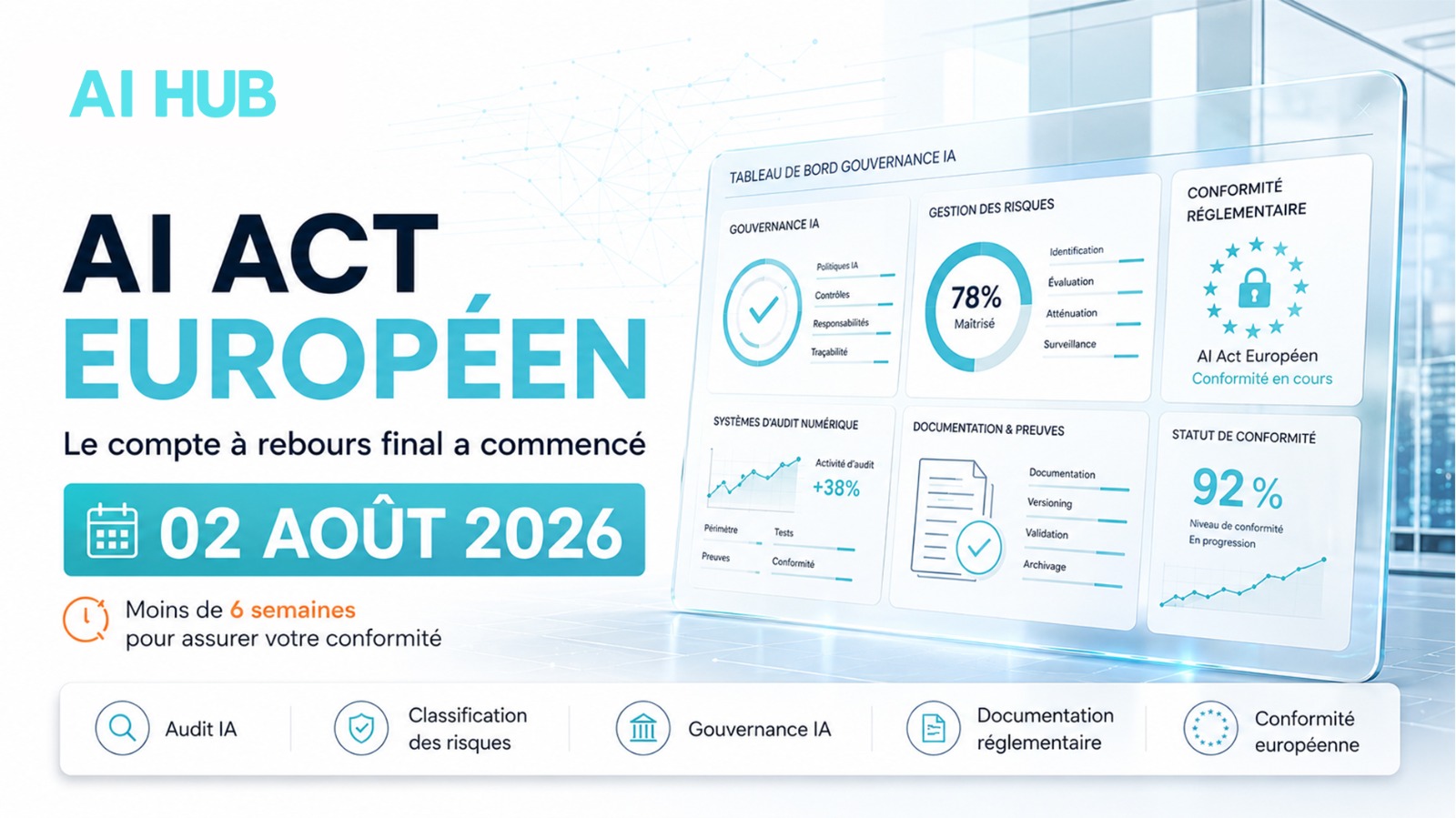
August 2, 2026 marks the full application of the AI Act for high-risk AI systems listed in Annex III, with the exception of certain systems whose deadline was pushed to December 2, 2027 following the Digital Omnibus political agreement of May 7, 2026. Concretely, companies must have completed the following steps.
In France, the CNIL, DGCCRF and Arcom have been designated as national competent authorities to monitor compliance and sanction offenders from September 2026.
- Completed a compliance audit of their AI systems.
- Established complete technical documentation.
- Completed a documented risk assessment.
- Registered their systems in the official EU AI database.
- Designated an internal AI compliance officer.
What About African and Moroccan Companies?
European regulation has a global reach as soon as a company touches the European market, whether through its clients, partners or digital products. A Moroccan startup selling an HR tool in Europe, or processing data of European citizens, is subject to the AI Act.
It is both a challenge and an opportunity: companies that anticipate compliance have a major competitive advantage to access the European market. Responsible and certified AI becomes a differentiating commercial argument.
Where to Start?
If you have not yet started your compliance journey, here are the five first actions to take immediately.
- Inventory all your AI systems in production.
- Classify them according to the AI Act risk categories.
- Prioritize high-risk systems and launch the assessment.
- Establish internal governance with a dedicated AI officer.
- Get expert guidance to not miss the deadline.
Conclusion: Responsible AI, a Business Imperative
The AI Act is not just another bureaucratic constraint: it is the signal that the era of AI without guardrails is over. Companies that adapt quickly will not suffer from this regulation; they will make it a lever for trust and competitiveness.
The action window is narrowing. In 6 weeks, the first checks will begin. The question is no longer whether to comply, but how to do it effectively before August.
AI HUB supports you in your AI strategy and compliance journey. Contact us at www.aihub.ma.
AH
Author
AI HUB Editorial
Research Desk