
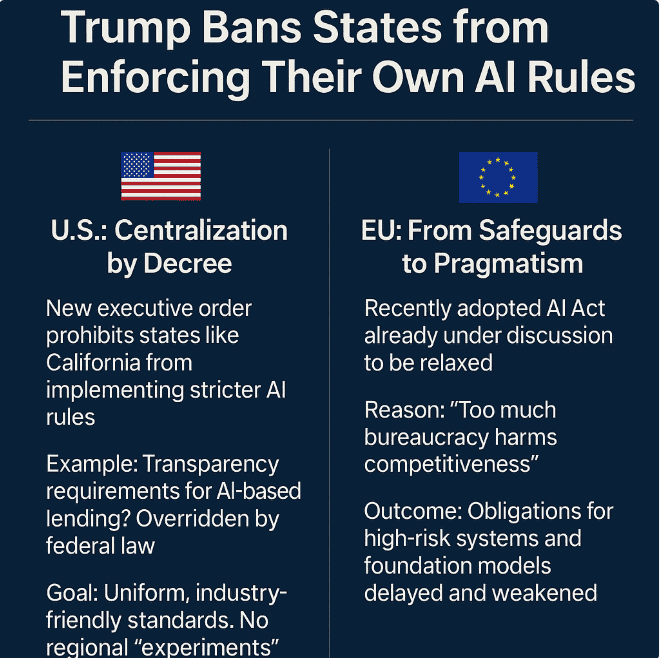
Key takeaways
- Unified national standard: Standardization of transparency obligations, potentially less burdensome for businesses.
- Major issue: Preventing compliance costs from hindering the scalability of tech giants.
- Deferred deadlines: Timelines extended until 2027 for certain high-risk systems.
- Administrative simplification: Reducing burdens to support local startups.
Strategic Disruption in the US
On December 11, 2025, a presidential decree set a strict federal standard, invalidating any more restrictive local regulations issued by federated states (e.g., California or Colorado).
The goal of this centralization is crystal clear: preventing regulatory fragmentation to maintain American computing power and innovation speed against Chinese giants and the EU.
- Unified national standard: Standardization of transparency obligations, potentially less burdensome for businesses.
- Major issue: Preventing compliance costs from hindering the scalability of tech giants.
The EU Pragmatic Pivot
While Washington centralizes, Brussels is shifting towards economic pragmatism with the 'Digital Omnibus' of November 2025.
- Deferred deadlines: Timelines extended until 2027 for certain high-risk systems.
- Administrative simplification: Reducing burdens to support local startups.
- European dilemma: Constant risk of being caught in a pincer between American speed and Chinese catch-up.
Impact on Citizens and Businesses
- Regulatory fragmentation: Global actors will have to manage two complex frameworks (US vs. EU).
- Citizen rights: Risk of reduced transparency and recourse for individuals regarding AI-made decisions.
AH
Author
AI HUB Editorial
Research Desk