Key takeaways
- End of smartphones: no more traditional phones by 2030-2031 according to Musk.
- AI as the single interface: one AI will replace all applications.
- Natural interaction: speech, gestures, even thoughts via Neuralink.
- The revolution is already happening: technologies converge faster than expected.
Key points of the revolution
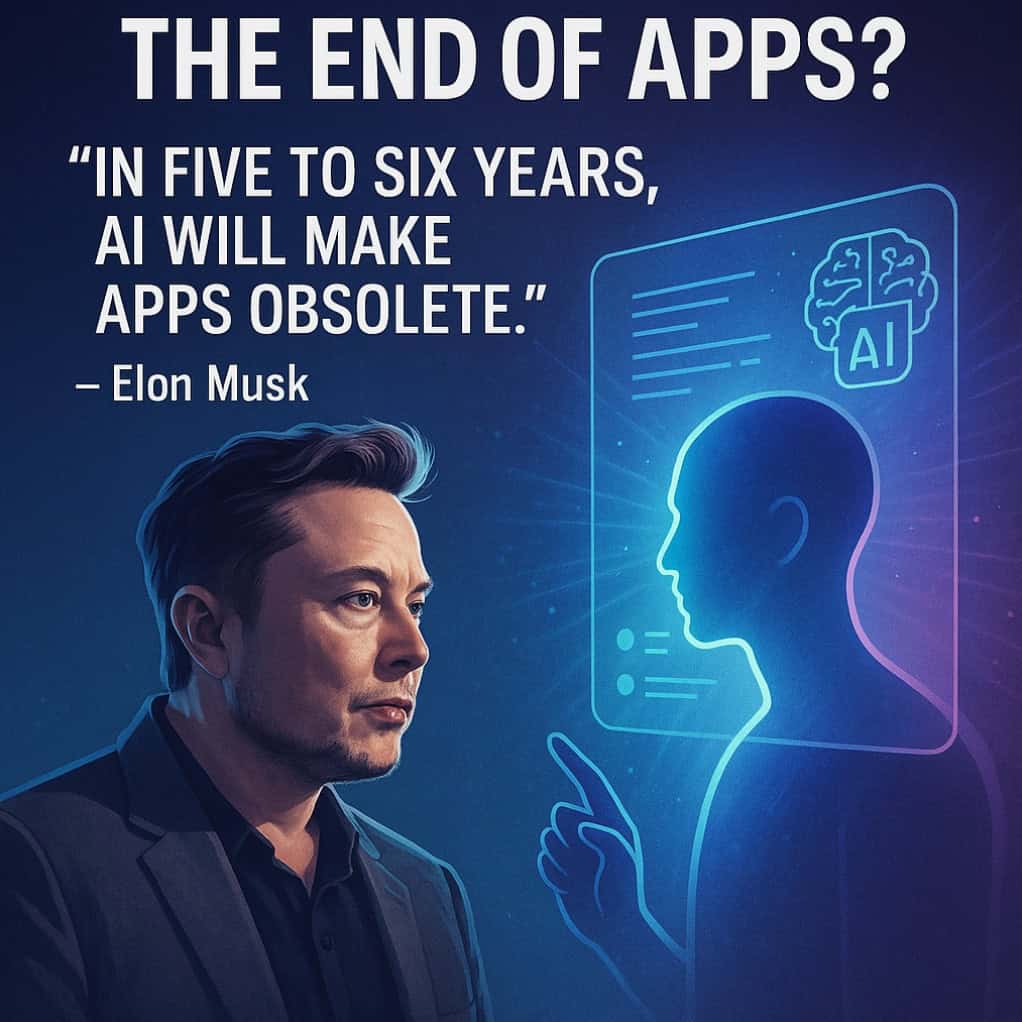
Elon Musk has repeated it in recent weeks, notably with Joe Rogan: the era of smartphones and apps is over. By 2030-2031 we will no longer have phones in the traditional sense. Instead, an ultra-powerful AI will become our only interface with the world. This is not science fiction — the revolution is already underway.
- End of smartphones: no more traditional phones by 2030-2031 according to Musk.
- AI as the single interface: one AI will replace all applications.
- Natural interaction: speech, gestures, even thoughts via Neuralink.
- The revolution is already happening: technologies converge faster than expected.
1. The sentence that flipped everything & why apps are doomed
According to Musk, opening an app, tapping icons and navigating menus will feel as archaic as using a rotary phone in 2010. Tomorrow you will simply say (or think): ‘Book me a table for 4 at the local Japanese restaurant at 8:30 pm, and find a taxi to pick me up at 8:05.’ And it will be done — without opening a single app.
Apps are rigid boxes that force us to think like they do. AI does the opposite: it learns how we think, our habits, our priorities. Soon your AI assistant will know your tastes better than your best friend and anticipate your needs before you voice them.
2. What it actually changes in our lives
This shift goes well beyond tech — it will reshape our relationship to the world.
- Less screen time → more real human interactions.
- Productivity multiplied: AI handles calendar, emails, finances, errands — everything.
- Real emotional support: an empathetic AI available 24/7.
- End of toxic multitasking: a single, flowing conversation with your assistant.
3. The last obstacles (and why they will fall)
Challenges remain: energy consumption of giant models, regulations on privacy and monopolies, social acceptance of direct thought (Neuralink).
But Musk is already on it: xAI develops Grok to be as truth-seeking as possible, Neuralink advances rapidly, and ever-more-efficient chips finally enable massive local inference. Everything is converging.
Conclusion: get ready, it’s coming faster than we think
In 5 to 6 years your current phone will sit in a museum next to the Nokia 3310. Technology will finally become invisible and, for the first time, will truly work for us rather than the other way around. The future is no longer a matter of ‘if’ but ‘when’ — and according to Musk, that ‘when’ is closer than we think.
AH
Author
AI HUB Editorial
Research Desk