
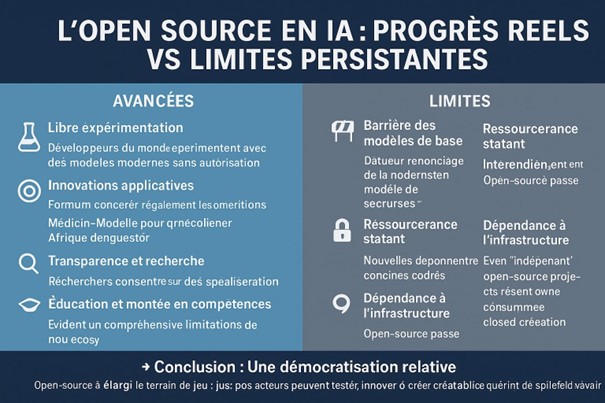
Key takeaways
- Freedom of experimentation: Creativity without prior authorization.
- Applicative innovation: Adaptability of models to sectoral needs (Health, Education, Industry).
- Transparency and Research: Ability to audit models to detect biases and errors.
- Skill building: Democratization of access to cutting-edge technologies for students and makers.
Open Source: A Catalyst for Innovation
Open Source hasn't overturned the big players, but it has radically transformed the energy of the market.
Sharing weights and code today allows a multitude of developers to experiment without the barriers associated with closed API access.
- Freedom of experimentation: Creativity without prior authorization.
- Applicative innovation: Adaptability of models to sectoral needs (Health, Education, Industry).
- Transparency and Research: Ability to audit models to detect biases and errors.
- Skill building: Democratization of access to cutting-edge technologies for students and makers.
Limitations and Economic Realities
Open Source has structural limits that no one can ignore.
- Massive Capital: Training benchmark models costs millions in GPU servers (e.g., H100).
- Data Monopoly: Essential data is held by a few giants (Meta, Google).
- Talents: Expert concentration remains a stronghold of large corporations.
AH
Author
AI HUB Editorial
Research Desk