AI4Morocco HealthAI4HealthAI Diagnosis MoroccoAI Health MoroccoAI medical imagingartificial intelligence medicine Moroccodigital health MoroccoTelemedicine Morocco
Introduction
Morocco faces a public health paradox: a country undergoing an epidemiological transition, with chronic diseases on the rise, under-medicalized rural areas, and an aging population—but also a scientific and technological community capable of designing innovative solutions. It is precisely at this crossroads that AI4Morocco established the IA4Health working group.
This group brings together doctors, data scientists, biomedical engineers, university researchers, and public health professionals around a shared conviction: artificial intelligence is not a threat to human medicine, but its best potential ally—provided it is developed in a rigorous, ethical manner adapted to the Moroccan context.
Medical imaging: the most advanced field
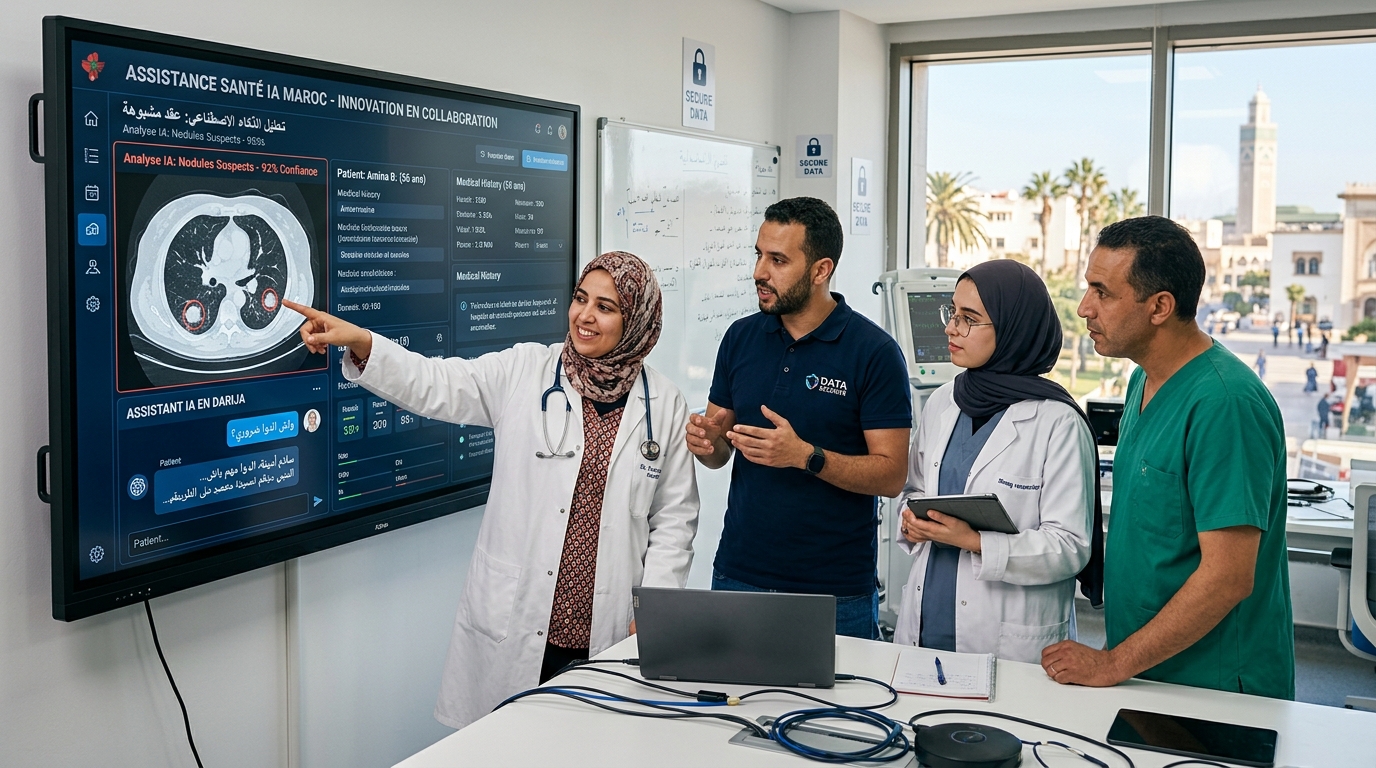
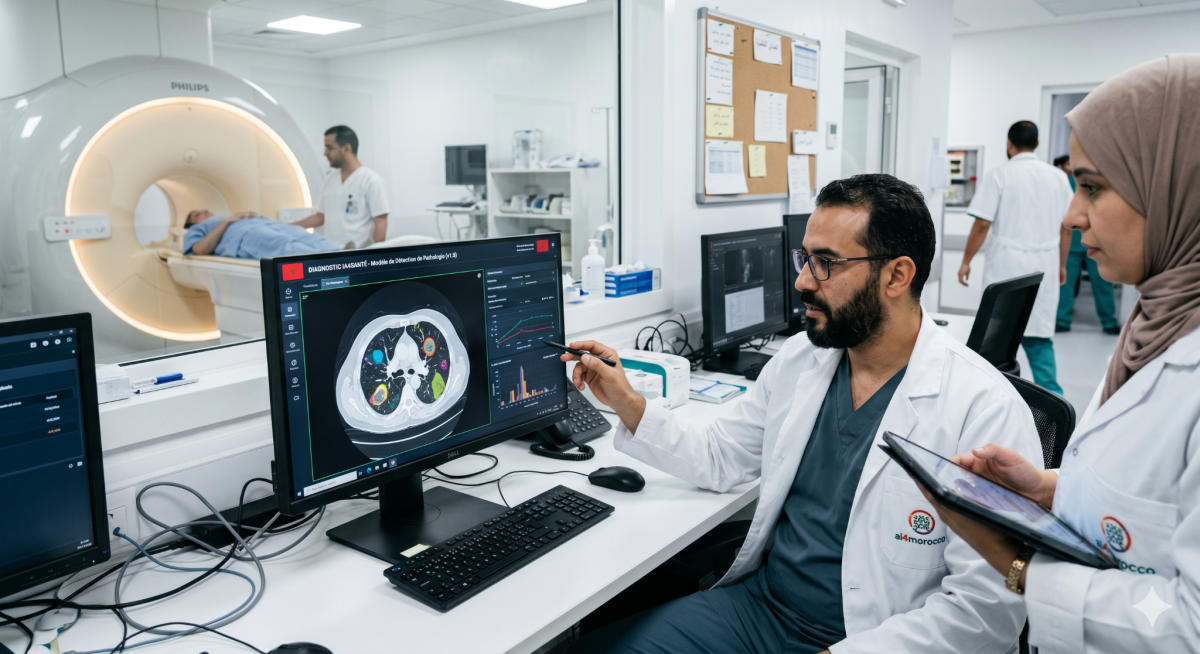
One of the most concrete focuses of the IA4Santé group concerns medical imaging and radiology. Worldwide, AI systems capable of analyzing X-rays, MRIs, and CT scans reached in 2025 levels of accuracy comparable to those of human specialists for the detection of certain cancers, notably lung, breast, and prostate cancer.
In Morocco, where the radiologist-to-population ratio remains very insufficient—particularly in the regions of Oriental, Drâa-Tafilalet, or Guelmim-Oued Noun—these tools represent a real opportunity to reduce diagnostic delays and improve access to specialized care. The IA4Santé group is working to identify public and private hospital partners likely to host pilot projects for AI assistance in radiology.
Predictive diagnostics: anticipating before curing
The other major project of the group concerns predictive diagnostics. The idea is simple in principle: by analyzing aggregated health data — test results, medical histories, socio-economic data, environmental factors — an AI system can identify patients at high risk for certain diseases even before symptoms appear.
For Morocco, the most relevant applications concern type 2 diabetes (with a prevalence exceeding 12% among adults according to the latest data from the Ministry of Health), hypertension, certain high-incidence cancers such as cervical cancer, and complications related to cardiovascular diseases. The group is working on the conditions for the ethical collection and use of health data, in close collaboration with the AI Ethics & Digital Trust group of AI4Morocco.
AI-Augmented Telemedicine
The Covid-19 pandemic has accelerated the adoption of telemedicine in Morocco, but remote consultations remain limited by the quality of internet connectivity in rural areas and by the lack of decision-support tools for general practitioners who must manage complex cases without a specialist immediately available.
AI systems capable of assisting a general practitioner in real time—by analyzing described symptoms, suggesting diagnostic leads, and signaling warning signs—could transform primary care medicine in Morocco. The IA4Santé group is exploring these possibilities while taking into account real constraints: spoken languages (dialectal Arabic, Amazigh, French), patients' levels of digital literacy, and the availability of infrastructure.
The Data Challenge: Building with What We Have
One of the most frequently cited obstacles by members of the IA4Santé group is access to high-quality, structured, and anonymized medical data. Without data, there is no model training. And without data representative of the Moroccan population, models trained on Western data are likely to perform poorly or be biased in the local context.
The group is therefore working on two parallel fronts: on one hand, advocacy for the creation of open and anonymized Moroccan medical datasets, in partnership with university hospitals and the Ministry of Health; on the other hand, the exploration of federated learning techniques that allow training models on distributed data without centralizing it, thereby preserving patient confidentiality.
What you can do
If you are a healthcare professional, researcher, developer, or simply a citizen convinced that AI can improve health in Morocco, the IA4Santé group is open to all profiles. AI4Morocco believes that the best solutions arise from the diversity of perspectives — that of the doctor who knows the field, the data scientist who masters the models, and the patient who experiences the reality of the healthcare system.
AH
Author
AI HUB Editorial
Research Desk