Key takeaways
- Almost all businesses are connected. According to the HCP (2019 data), 81% of VSEs, 97.9% of SMEs, and 99.5% of large companies had internet access (TelQuel).
- SMEs report progress. In an EIB/EU survey of 150 Moroccan SME leaders (February 2026), nearly 8 out of 10 SMEs declared a digitalization effort: 22% at a very advanced level, 57% at an average level (maroc.ma).
- Structured digitalization remains a minority. The HCP estimates that 23% to 30% of SMEs have undertaken a structured approach (ERP, CRM, e-commerce) (Team France Export).
- Integrated use is rare. In its July 2026 report, the World Bank indicates that less than one in five Moroccan businesses makes intensive and integrated use of advanced digital technologies (TelQuel).
CRM in Morocco: An Integration Imperative for SMEs
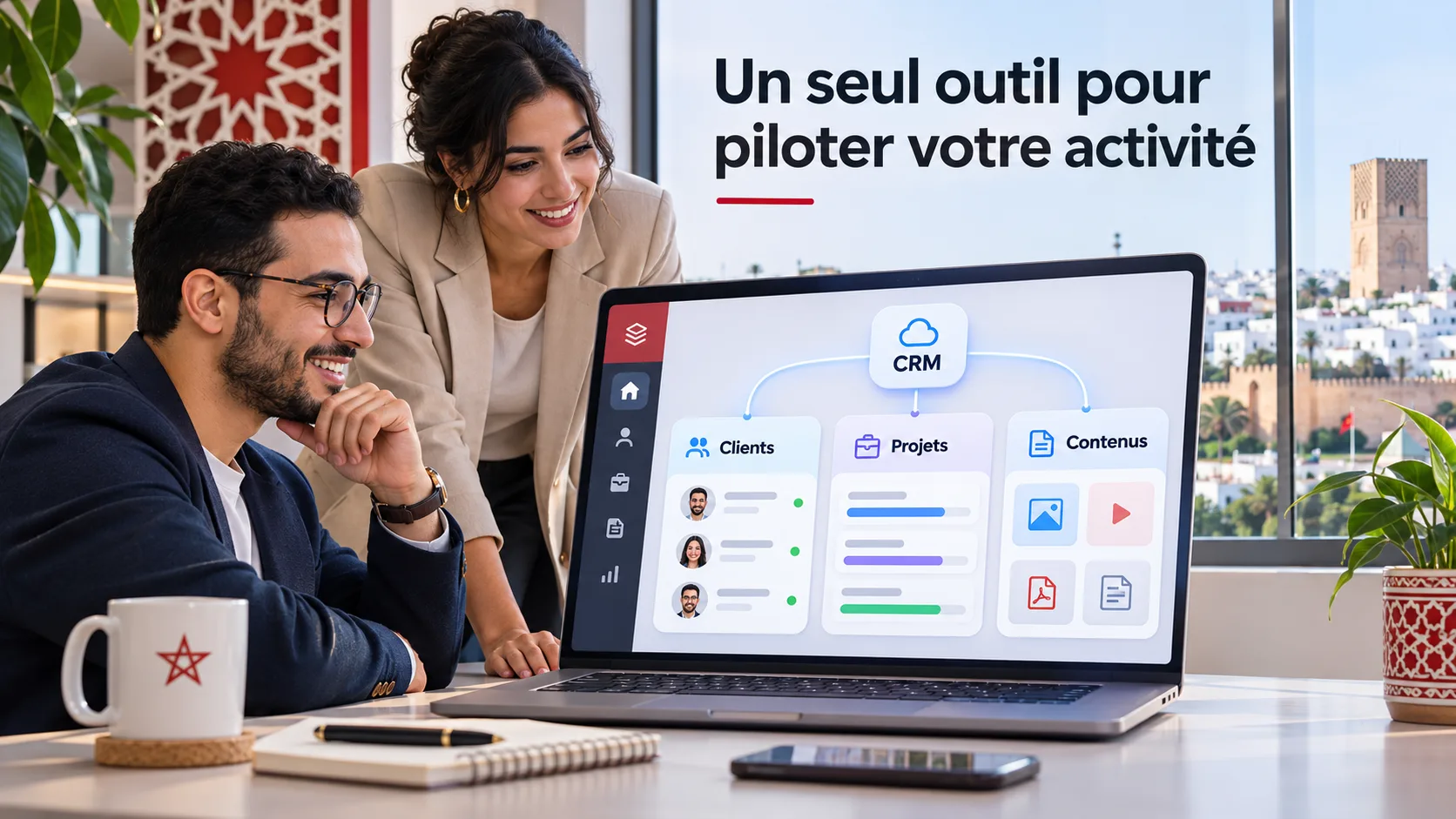
Moroccan businesses are connected, but their client, project, and content tools rarely remain linked. This is precisely the gap that a well-designed CRM can fill, and it is the raison d'être of CRMCM, the CRM and content platform we are building at AI Hub, in Rabat.
Transparency: CRMCM is currently presented at the vision stage. The functionalities described here are envisioned and not all are yet delivered.
The Moroccan Market: High Connectivity, Low Integration
The challenge is no longer to bring businesses online, but to connect their tools. Some recent benchmarks:
Our interpretation: the gap between 'equipped' and 'integrated' is the space for a CRM. Many teams already have tools. Few have linked them in a single workspace.
- Almost all businesses are connected. According to the HCP (2019 data), 81% of VSEs, 97.9% of SMEs, and 99.5% of large companies had internet access (TelQuel).
- SMEs report progress. In an EIB/EU survey of 150 Moroccan SME leaders (February 2026), nearly 8 out of 10 SMEs declared a digitalization effort: 22% at a very advanced level, 57% at an average level (maroc.ma).
- Structured digitalization remains a minority. The HCP estimates that 23% to 30% of SMEs have undertaken a structured approach (ERP, CRM, e-commerce) (Team France Export).
- Integrated use is rare. In its July 2026 report, the World Bank indicates that less than one in five Moroccan businesses makes intensive and integrated use of advanced digital technologies (TelQuel).
Operational Challenges for Moroccan SMEs: Field Observations
These observations come from our experience at AI Hub and with the AI4Morocco community. These are not statistics.
- Small teams where everyone does everything. The same person prospects, follows clients, and publishes on social networks.
- Fragmented client exchanges between calls, emails, and messaging apps like WhatsApp, making them difficult to retrieve later.
- Communication in multiple languages: French, Arabic, and Darija depending on the audience.
- Little visibility on results. We publish and follow up, but we poorly measure what brings returns.
- No dedicated technical team. The tool must remain simple to use.
CRMCM: AI Hub's Integrated Response to Market Needs
Facing these challenges, CRMCM is designed to offer a targeted and effective response, by integrating several key functionalities:
Two honest clarifications: the integration of messaging channels like WhatsApp is not announced at this stage, and the supported languages will be specified as development progresses.
- For dispersed information: A unique space for contacts, exchanges, opportunities, and projects.
- For small teams: AI that retrieves information, suggests ideas, and drafts, to save time.
- For continuous content production: Content creation adapted to channels and brand identity, with calendar and publication.
- For unclear results: An overview of ongoing actions and follow-up on feedback.
- For no technical profile: A tool designed for small structures, without a dedicated technical team.
CRMCM's Intuitive Workflow: Understand, Organize, Advance
CRMCM follows three simple steps:
A concrete example: a prospect contacts the company, the team tracks their need in the platform, prepares an adapted campaign, then publishes and monitors feedback. The same tool supports each step.
- Understand: find clients, their needs, and their context.
- Organize: structure projects, actions, and content.
- Advance: disseminate, track feedback, and measure results.
AI at the Service of Humans: A Collaborative and Ethical Approach
In CRMCM, AI relies on the company's context to retrieve information, suggest ideas, draft, and prepare actions. Each proposal can be accepted, modified, or rejected. Important decisions remain in the hands of the team.
This is an important choice in a market where trust and human relationships matter: AI reduces repetitive tasks; it does not replace judgment.
A Favorable Context for Digital Innovation in Morocco & Target Audience
The Maroc Digital 2030 strategy places VSEs and SMEs at the heart of digital transformation, notably with announced subsidies for technology companies developing innovative solutions (Hespress FR). Businesses have tools and willingness. They lack a simple way to connect everything.
CRMCM is specifically aimed at:
- Small businesses, startups, agencies, and service structures, without a dedicated technical team.
- Sales, marketing, and communication teams, who track prospects, clients, and campaigns.
- Coordinators of clients, training, events, or projects.
Frequently Asked Questions and Call for Collaboration
We are building CRMCM with the realities of Moroccan businesses in mind. What is your biggest difficulty in tracking your clients or your communication? Write to us at aihub.ma and follow the Build by AI Hub series to discover PAM, FEED, and QuickCheck AI.
Sous-titre 1
Because its contacts, exchanges, and projects are often spread across multiple tools. A CRM brings them together to retrieve information and track each client.
Sous-titre 2
Not yet in its entirety. The product is at the vision stage, and its functionalities are envisioned.
Sous-titre 3
No. AI proposes, drafts, and prepares. The team accepts, modifies, or rejects.
Sous-titre 4
The goal is a simple workspace, designed for teams without a dedicated technical profile.
Sous-titre 5
- TelQuel: column on the preparation of Moroccan businesses (HCP, World Bank)
- maroc.ma: EIB/EU survey on Moroccan SMEs
- Team France Export: Morocco market brief
- Hespress FR: Digital Morocco 2030
Author
AI HUB Editorial
Research Desk