
Key takeaways
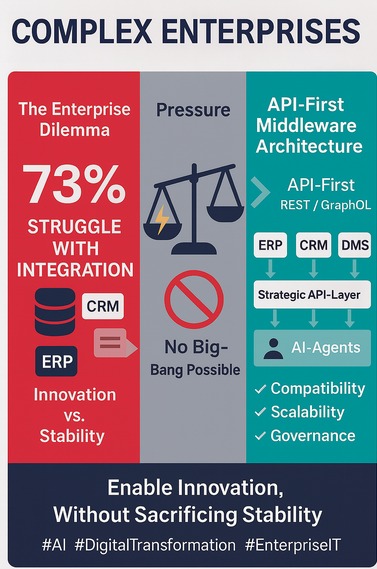
- Innovation pressure: leverage AI to stay competitive.
- Stability requirement: do not endanger business-critical processes.
- Reality: a ‘Big Bang’ migration is not a viable option for most.
- Task management and data routing.
The dilemma of established companies
While start-ups can build their AI strategy on a blank sheet, established companies face a very different challenge: how do you integrate intelligent agents into an IT system built and complexified over years?
The reality is clear: 73% of German companies struggle to integrate AI technologies into their existing systems. The issue is not a lack of AI skills, but the complexity of legacy IT infrastructures — ERP, legacy databases, CRM platforms and proprietary applications.
The paradox: innovation vs stability
Large companies find themselves in a permanent dilemma. According to Gartner, by 2026 more than 80% of companies will adopt hybrid AI integration approaches rather than fully replacing their existing systems.
- Innovation pressure: leverage AI to stay competitive.
- Stability requirement: do not endanger business-critical processes.
- Reality: a ‘Big Bang’ migration is not a viable option for most.
The solution: an API-First middleware architecture
Based on enterprise best practices and recent research in multi-agent systems, a structured middleware architecture stands out as the best path.
API-First approach
AI agents are plugged in as modular services via REST or GraphQL APIs. This decouples agent logic from business applications and enables flexible integration with ERP, CRM, DMS and web apps.
Strategic API layer
A unified API layer aggregates key internal systems (ERP, PIM, CRM, DMS) and exposes structured data to AI agents. An API Gateway ensures transparency, scalability and consistent security.
Middleware & orchestration
Battle-tested platforms (n8n, UiPath, IBM Watsonx, Automation Anywhere) handle:
- Task management and data routing.
- Workflow definition and exception handling.
- Process tracking and agent monitoring.
Why this approach works
Key message: enable innovation without sacrificing stability.
In Part 2 we will cover concrete implementation, a step-by-step methodology, and critical success factors from the field.
- Maximum compatibility: secure integration without disrupting existing systems.
- Modular scalability: flexibly add new AI agents as services.
- Future-proof architecture: dynamic evolution free from legacy constraints.
- Strong governance: GDPR compliance built in by design.
AH
Author
AI HUB Editorial
Research Desk


