
Key takeaways
- Software Robots (RPA - Robotic Process Automation): For digital, repetitive, rule-based tasks.
- Physical Robots (Cobots - Collaborative Robots): Designed to work in secure interaction with humans.
- Invoicing: Automatic data extraction from invoices, accounting entry, and payment order preparation.
- Order processing: Stock verification, delivery note generation, sending client confirmations.
Two Approaches for Your SME
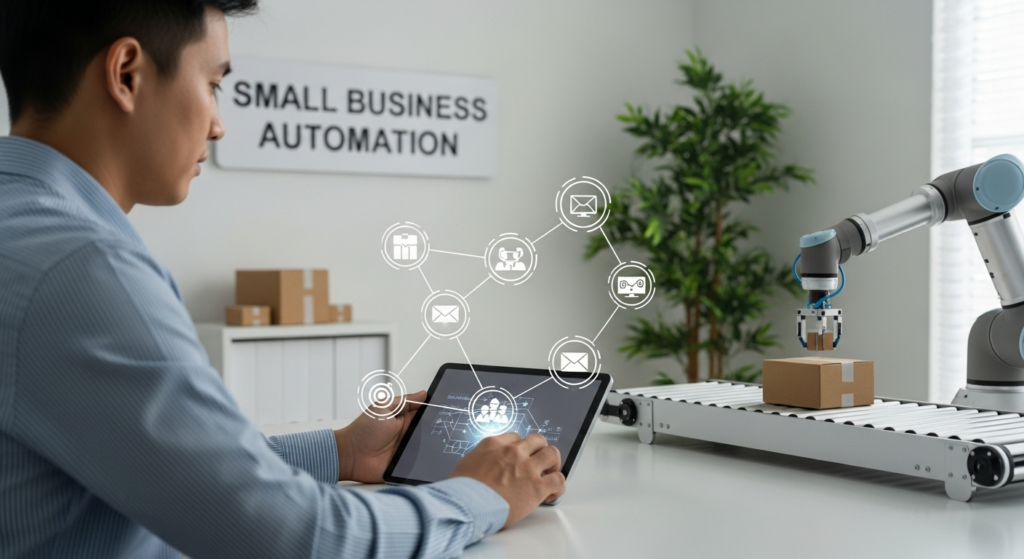
In 2025, robotization has an accessible face for small and medium-sized businesses through two major avenues.
- Software Robots (RPA - Robotic Process Automation): For digital, repetitive, rule-based tasks.
- Physical Robots (Cobots - Collaborative Robots): Designed to work in secure interaction with humans.
What Can Software Robots (RPA) Do?
- Invoicing: Automatic data extraction from invoices, accounting entry, and payment order preparation.
- Order processing: Stock verification, delivery note generation, sending client confirmations.
- CRM/Excel Integration: Automating copy-pasting between business tools.
- Reporting: Data collection from multiple sources (Analytics, CRM) to automatically create dashboards.
Cobots: Human-Machine Collaboration
Unlike rigid industrial arms, cobots are designed to assist your operators with arduous or meticulous tasks.
- Assembly and Screwing: Precise, repetitive tasks while keeping humans for final validation.
- Quality Control: 24/7 camera inspection with unfailing accuracy.
- Pick & Place: Carton/product management on conveyor belts, preventing musculoskeletal disorders (MSDs).
- Machine tending: Automated loading/unloading to allow one operator to supervise multiple stations.
AH
Author
AI HUB Editorial
Research Desk